Sunday, 2 March 2014

Saturday 1st March 2014

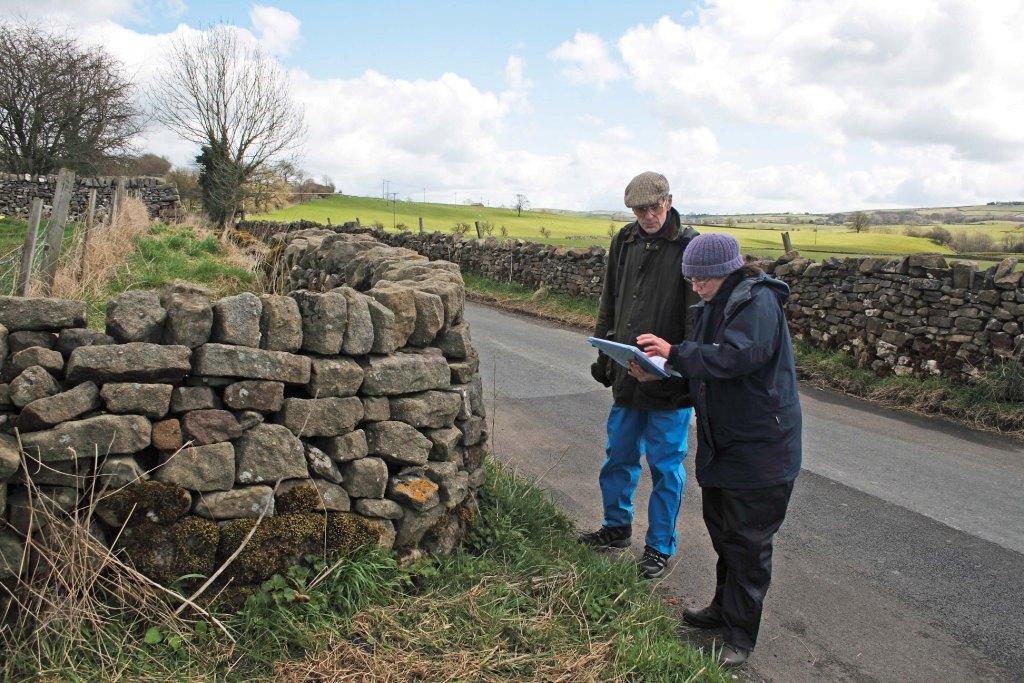
With the kind permission of a local farmer, 4 of the Embsay Research Team enjoyed a good day out studying the wall of a large field in Eastby. The weather was kind despite the threat of rain, and we only really got cold while sitting still over our lunch break.
 
(c)  Jane Lunnon


The field proved to have a complicated wall structure with several different types and ages of drystone walling surrounding it, all of which adds to the growing picture of how the field systems in the parish developed through the centuries. The surviving gateposts were all fairly similar in character, matching some of those we find elsewhere in the parish, and indeed across the Dales.

The discovery of an old revetted wall down a now disused enclosed lane, running alongside one side of the field, proved very interesting – this is a feature which can also seen down Low Lane, and we know of another excellent example in the neighbouring parish of Halton East. These may be indicators of rights of way going back to at least the medieval period.
(c)  Jane Lunnon 
As ever, Tony’s trousers remained virtually pristine clean while the rest of us ended up with mud coating our trousers up to our knees! We returned home at the end of the day for a cuppa and a slice (or two!) for Sue’s excellent home-made chocolate cake. 

Jane Lunnon 

Sunday, 23 February 2014

Saturday 22nd February 2014

At last today we finished the surveying of the walls along Low Lane, despite having to dodge the cars, bikes, joggers and horses!
Tony, Chris and Sue absorbed in their survey  (c) Jane Lunnon
After lunch, when the cold biting winds got to us a bit as we stood still, we took a stroll over the footpath behind Water Lane Laithe towards the railway embankments. Here is a wall which - although probably built by the Midland Railway company in the 19thC – appears to mark the line of a much older boundary – the southern edge of Embsay township. The presence of a ditch running inside it confirms this together with documentary evidence that we have.
It's a dirty job - but someone has to do it!  (c) Jane Lunnon

It was a muddy walk and we were greeted by a couple of eager sheep under the delusion that we were here to feed them.

Now we look forward to our next session when we will get off the surprisingly busy road of Low Lane, and onto some of the footpaths around the parish.


Jane Lunnon

Monday, 27 January 2014

25th January 2014

It was cold but a bright morning. Three of us wrapped up warm and strolled down Low Lane to continue the walls surveying. We headed for Kempley Beck (which changes its name to Rowton Beck when it gets to Eastby). This beck is the ages old boundary between Embsay and Eastby. 

We were hailed by the local molecatcher, wondering if we were lost because we were studying our map. 
He seemed a bit bemused when we explained we were studying the old drystone walls across the parish - no doubt he thought us a bit mad. He was a cheerful chap, and proudly showed off his bucketful of the dead "little b---rs" that he'd been digging up this week. Not quite the surviving link into local history we had been expecting today! Apparently he donates his earnings as molecatcher to the Alzheimer's Society.  

David and Chris at the Kempley Beck    (c) Jane Lunnon
We managed to get a couple of hours of recording walls done before the rain set in and our fingers became too numb to write. We were pleased to find a small length of stone revetted bank and remnants of an ancient thorn hedge, matching similar features further along the roadside. We also found another good example of a polegate-post to add to our growing list.

Jane Lunnon


Saturday, 12 October 2013

On Friday evening, 4th October, ERG member David Turner gave a talk at Embsay Village Hall. It was an excellent presentation based around a little card lent to him by local resident John Smith. An intriguing little note scrawled on the back of an invitation to a  Victorian musical soiree launched David into a fascinating journey as he researched the man who wrote it and the possible story behind the note.  His research was, as always, very thorough and the result is a lovely story, although still full of questions which may never be answered. Everyone enjoyed the evening and there was quite a buzz over the coffee and biscuits afterwards.


David will be giving the talk to other local societies over the next few months (see dates below) – hopefully the story will be posted on the UWHG website’s Embsay Pages early next year.  

Thurs. 24th October 2013 - "The Poor Man and the Lady" at Skipton & Craven History Society, Swadford Centre, Skipton (7.30pm)

Wed. 4th Dec. 2013 - "Come thou vilest sinner - The rise and fall of the Primitive Methodists in Embsay and Skipton, 1821-1932" - Skipton Civic Society, Soroptimists Rooms, Otley Street, Skipton (7.30pm)

Wed. 11th Dec. 2013 - "The Poor Man and the Lady" - Friends of the Museum, Skipton Town Hall (7.30pm) 

Thurs. 16th Jan. 2014 - "Come thou vilest sinner - The rise and fall of the Primitive Methodists in Embsay and Skipton, 1821-1932" - Embsay Methodist Guild, Methodist Church, Embsay (1.45 pm)

Jane Lunnon

Monday, 7 October 2013

 Sunday 6th October 2013 

Chris, Jane and Alan met up at Halton Heights and set off on the long march up the footpath over Barden Moor, passing several boundary stones on the way.

Our aim was to get to Dolly Roggin, a large boundary stone on the edge of Embsay parish. It has already been surveyed, but not photographed in detail.

Dolly Roggin is a huge earthfast boulder that stands at the junction of Embsay, Rylstone and Barden parish boundaries – it’s an impressive stone on a sheltered hillside with a good view of Upper Barden reservoir below.  An iron fence post was embedded in its top face, probably in the 19th Century, and further similar metal fence posts can be seen nearby.

We enjoyed a leisurely packed lunch before Alan set about carefully photographing the stone in detail and overview. The sun same out for a few minutes here and there, but the light was mostly rather grey as brooding clouds hung overhead.  We returned from our visit to Dolly Roggin via the boundary stone t Peggy West’s well, one we had surveyed and photographed several months ago.

As we approached the end of our walk of course the sun came out and the temperature rose. A chilly autumn day suddenly became an Indian summer.


 Jane Lunnon   

Saturday, 31 August 2013

Summer 2013.

It's been an extremely busy summer - yet it would seem on the surface that not much has been happening with the Embsay project. Our commitments with other projects within the Upper Wharfedale Heritage Group have meant we haven't been able to give Embsay research as much time as we would have liked. However, that doesn't mean we haven't been fully occupied!
Jennifer Stearn with the Embsay Children's Centre summer school at Whitfield Syke (c) photo by Ruth Spencer
Work on the genealogical database is steadily ongoing - we now have over 11,000 individuals on the database and it's still growing on a daily basis. The archives of the Craven Herald newspaper are being searched for all references to Embsay and Eastby - since these are all on microfilm it's a very slow process and requires a lot of patience and eyestrain. We are nearing completion on our analysis of the census returns - Only 1901 and 1911 to go through now. We have also almost completed our extraction of data from parish registers / monumental inscriptions and related sources. A start is being made on other sources such as Wills at the Borthwick Institute. 

The survey of the field walls has been stalled by the high summer vegetation which makes it very difficult to examine the stonework closely, but work will resume in the autumn. 

The survey of boundary stones across Embsay Moor is almost complete - there remains just one last stone to record. A talk will be given on the findings of the survey at the Christmas meeting of the Upper Wharfedale Heritage Group. 

We are also preparing to give 2 talks at the Embsay Village Hall in October - details will be circulated nearer the time. 


Pat Carroll teaches two girls how to plot their finds (c) photo by Ruth Spencer

Some UWHG members recently spent a day at the Embsay Children's Centre, with children of various ages from 4 to 10 who were attending for the summer holidays.
Phil with a captive audience at Whitfield - or is it the other way round? (c) photo by Ruth Spencer
They took the children up to the Whitfield Syke mill, where Phil told them the amusing story about the water rights dispute. The children then went "fieldwalking" and took their finds back to the Centre in Embsay to process them. There were more finds waiting to be dug up in the Centre's own sand-pit.
Pat and Jennifer help the children dig up some finds in the sand-pit (c) photo by Ruth Spencer

And finally, the Embsay Research Team are very pleased to have a new member, John Weatherill, who is starting to tackle the large number of archive documents which need transcribing. This will open up a huge new area of information for us on the history of the parish. 

Jane Lunnon

Thursday, 2 May 2013

Saturday 27 April 2013

5 of us spent another day surveying field walls  along Low Lane. We started at Water Lane (the footpath which goes off the road towards Eastby) and split into two teams, recording the walls on both sides of the road, finishing by the end of the day at the boundary with Halton East. 


Particularly interesting features that we recorded along the way were the pole gatepost which had probably been removed from its original location and is now acting as an anchor for the end of a wood and wire fence. Unfortunately it lies outside the National Park boundary so we can't submit the details for the Park's Feature of the Season database. But we have recorded it in detail. The variety of gateposts is really becoming quite interesting and we shall be producing a page for the UWHG website on the different types of gateposts that we find across the parish. Also of particular interest was the cast iron water trough we found set down into the ground, the remains of a structure which may have been a small barn or large animal enclosure, a beautifully built stone culvert running under the road, and an intriguing stone-revetted bank which runs behind an old thorn hedge. All things which we have driven past in the car hundreds of times without ever noticing before. 


On the way home we were careful not to disturb the duck in her nest in the roadside verge - let's hope her poor choice of nesting site doesn't prove disastrous when she hatches her ducklings. 

Jane Lunnon