Saturday, 9 December 2017

Wednesday 6th December 2017

We had a lovely day today – chatting with Gareth and Nicole Beale about their exciting new project “Discovering England’s burial spaces”. We are genuinely really pleased that they have chosen us as one of their case studies. As they develop a model for community groups to adopt for graveyard surveys and recording, we hope our experiences and the lessons we have learned as a small local heritage group will prove helpful to Gareth and Nicole.

We had an interesting discussion about authority files for describing gravestones – physical appearance, condition monitoring and design features – as well as ideas on survey form structures, and the practicalities of using mobile apps over paper forms. A very important aspect of the project is that of affordable data storage and archiving which is something we are very concerned about. 


The recent CBA (Yorkshire) showcase for community heritage groups had made us very aware of the need for sharing good practice and project findings not only between local groups, but also with academics. Publication and dissemination is a vital component of research, yet local case studies are susceptible to being unnoticed and unappreciated beyond their local community.   
Ralph decidedly unimpressed with discussions on database modelling
  We look forward to taking part in the project.


Jane Lunnon

Saturday, 2 December 2017

Thursday 30 November 2017

We have just spent 2 days brushing up on our RTI photography in 2 burial grounds.

On Wednesday we went to Skipton – at the invitation of Jean Robinson, of the Friends of Raikes Road Burial Ground we took a series of RTI sequences for 6 gravestones considered to be most at risk from weathering over this coming winter.

Erosion typical of Raikes Road Burial Ground
We were surprised that despite this burial ground being only 2 miles from Embsay, and opened at about the same time as St Mary’s churchyard, the nature and scale of erosion was very different. The main problem at St Mary’s, Embsay, is delamination, while at Raikes Road the stones are more likely to be weathered, the lettering blurred and fuzzy due to a powdery, friable granulation presumably caused by wind and rain. Raikes Road stands on a slope, facing towards the town. Perhaps this combined with a different quality of the stone used by Skipton masons has something to do with it – although some of the masons in Skipton also provided stones for Embsay churchyard. 

It was a cold, crisp day and the light was perfect for RTI. We finished off all 6 gravestones by lunch-time, and were able to get back to Embsay in time for a hearty, warming pub lunch at the Elm Tree Inn.

And so to Kettlewell Thursday. We arrived just after lunchtime, in order to avoid the very low temperatures of the morning. We took advantage of the brief “warmer” spell over the next couple of hours to set up our horizontal camera beam and have another go at the listed gravestone. We had taken RTI photos of this earlier in the year, but hadn’t been fully satisfied with the results. This time we didn’t try to fill the frame with the whole grave slab, but took two sets of photos to enable us to zoom in closer to the details of the carving. We also managed to avoid the bright sunlight of last spring’s session. Besides, this time when the sun did briefly shine, followed by a snow flurry, we were prepared with our umbrella attached to a tripod – although Sue did somehow manage to turn the umbrella inside out at first!

Using the horizontal beam for a ledger stone
Hopefully this will produce better results. The only problem is that we were unable to do anything about the ice embedded into the surface of the grave stone – it was so hard and thick that we couldn’t remove it without risking damage to the stone, so had to leave it in. It will be interesting to see how this new problem affects the results.

Jane Lunnon


Monday, 6 November 2017


Saturday 4th November 2017

Members of the Embsay Churchyard project attended the inaugural Council for British Archaeology – Yorkshire’s Autumn Showcase at the weekend in York. This was the first time community heritage groups across Yorkshire had been brought together to share their work, ideas and experiences. It was a great success – our Sue gave an excellent presentation for Embsay – despite each speaker only having 20 minutes, Sue packed a lot into her talk on how we had used RTI to advance and develop our project into something really exciting. She seems to have inspired others to start thinking about churchyard heritage too – as we had a lot of visitors to our stand asking about RTI.

There were some interesting workshops which some of us attended – such as Jon Kenny’s Project design and planning; a drone workshop; and LIDAR session.

At the end of the day some very interesting “food for thought” was put forward by archaeologist John Buglass, following up on the issue of networking for local heritage groups. Several comments had been made informally throughout the day that so many groups were beavering away and doing such wonderful work, yet we seem unaware of each other’s expertise, findings and potential to support each other and share experiences. It will be interesting to see if anything comes of John Buglass’s encouragement for this to be addressed.  Let’s hope the autumn showcase becomes an annual feature, and that more “professionals” and academics are encouraged to come along and see what “amateur” heritage can achieve.  

It was certainly an excellent opportunity to network with groups that are operating even quite close to our own little “patch”.


Jane Lunnon 

Monday, 23 October 2017

Saturday & Sunday, 21st – 22nd October 2017

We have spent a wonderful weekend down in West Sussex. Our Churchyard Survey team had been invited to deliver a 2-day workshop to the enthusiastic Lavant History Group, based near Chichester.

We met in St Nicholas Church and received a very friendly welcome from everyone and great hospitality all weekend.
Even Storm Brian, which threatened to disrupt the outdoor practical sessions, bypassed us.

It’s an interesting exercise to deliver such a workshop – it made us look again at our working practices, our aims and objectives, and consider how much we have learnt over the last two years.

It has given us extra impetus too – placing our knowledge of our Upper Wharfedale churchyards against the differences we found in the Lavant churchyards helps to give us a new perspective on our local case study.


The preparation and delivery of the workshop has also given us the opportunity to formalise our documentation as we start to consider how we are going to publish our study and share our knowledge and experience in print.


We have always said that one of our main objectives is to share our experiences and the lessons we have learnt from the project – and we couldn’t have hoped for a better reception than this weekend. We wish Lavant History Group every success with their churchyard project.

Jane Lunnon 

Tuesday, 26 September 2017

Wednesday 20th September 2017

One of the lessons we have learnt over the course of this project is that you need to assume that every detail is important no matter if it seems insignificant at first.
Now that we are more familiar with our gravestones and the cultural history bound up with them we are returning several times to re-take photographs and more detailed measurements. Such details as the very small carved motifs, the shaping of mouldings at the sides ; these should be recorded with as much care as the inscriptions.

When the weather permits we now take the opportunity to go back out into the churchyard and fill in some of these gaps with new measurements and photos.  Today was such a day and we enjoyed a nice day out in the open, while Jen rested her sprained foot, sitting at the laptop inside the church entering the new data. 

This is a serious business, I'll have you know .... 
Much of the afternoon was taken discussing arrangements for the weekend workshop we’ll be running down in Sussex soon. We conducted a test planning exercise using triangulation and scale drawing to assess the best scale to use for a churchyard. We have been lucky at St Mary’s Embsay in having a good plan already for the grave plots, but this is not available to everyone and we are aware we will probably need to make our own plans when we survey other churchyards.
Check. Double-check. ...
Speaking of which, we were pleased to make contact recently with the new project co-ordinator for the churchyard survey at Long Preston near Settle. We wish them every luck with their project and look forward to helping them in any way we can. It’s an exciting prospect to see others working on gravestones in the Dales.

And congratulations too, to Gareth and Nicole Beale for securing funding to develop their project at the University of York – “Discovering England’s Burial Spaces.” (more information at:  https://www.york.ac.uk/digital-heritage/events/debs-funding/)
Hopefully this will lead to the creation of a national database which will allow little projects like us to share our data and run comparative studies which will be meaningful on a national scale. We are genuinely excited about this project and its potential and feel very privileged to be involved.


Jane Lunnon

Thursday, 7 September 2017

Wednesday 6th September  

We ventured outside again in order to catch up on some of the missing photos that were needed, and to re-shoot those which needed better photos. It’s surprising over the past two years how much we have learnt about making a photo record and the details we should record – at the beginning of the project two years ago it didn’t really seem that important to photograph close-ups of little details such as motifs, mouldings, de-lamination, etc. Now we are much more aware how important such little details are in analysing the gravestones for their design features, condition monitoring, and stone masons’ idiosyncrasies.

The weather was a little variable but for the most part excellent for RTI purposes – dull, dry and wind-less.
Some stones needed the RTI re-doing, now that we are a little more proficient at the technique than we used to be; and some stones needed new photos as the old ones were not clear or detailed enough.
Example of the kind of detail we missed in the early days - distinctive decorative moulding at the base of a headstone 
We have found that full-scale RTI is not always necessary – the use of a flash light on a single photo shot is sometimes enough to reveal difficult-to-read inscriptions. So we decided we should try some “flashing in the churchyard” today. This rather unfortunate phrasing had us giggling like schoolchildren, but by the end of the day we had come up with a new terminology for the technique – “oblique lighting” – not so much fun, but better for use in polite company....

We had visitors too – a little group of visitors from Germany who were interested in our parish church, and later a passing little group who were walking up Kirk Lane, and stopped out of curiosity, wondering what on earth we were doing in the churchyard. 

It's the snooker ball that always catches the attention & curiosity of passers-by!
We invited them in and explained our project, and showed them some before and after RTI photos – which greatly impressed them. It’s always such a pleasure to share this project – we find most people are surprisingly interested when we explain what we are doing.  

In the afternoon we had to sit down inside the church and have a lengthy discussion on project management – we find ourselves being invited to share our project findings and help several other groups launch their own churchyard surveys. This is though, one of the joys of a project like this, and we really enjoy this aspect. So we discussed various options and plans, and have each come away with lots of preparation to do for presentations, workshops and photo shoots which are coming up over the next few months.

A busy day!


Jane Lunnon

Friday, 1 September 2017

Friday 1st September 2017

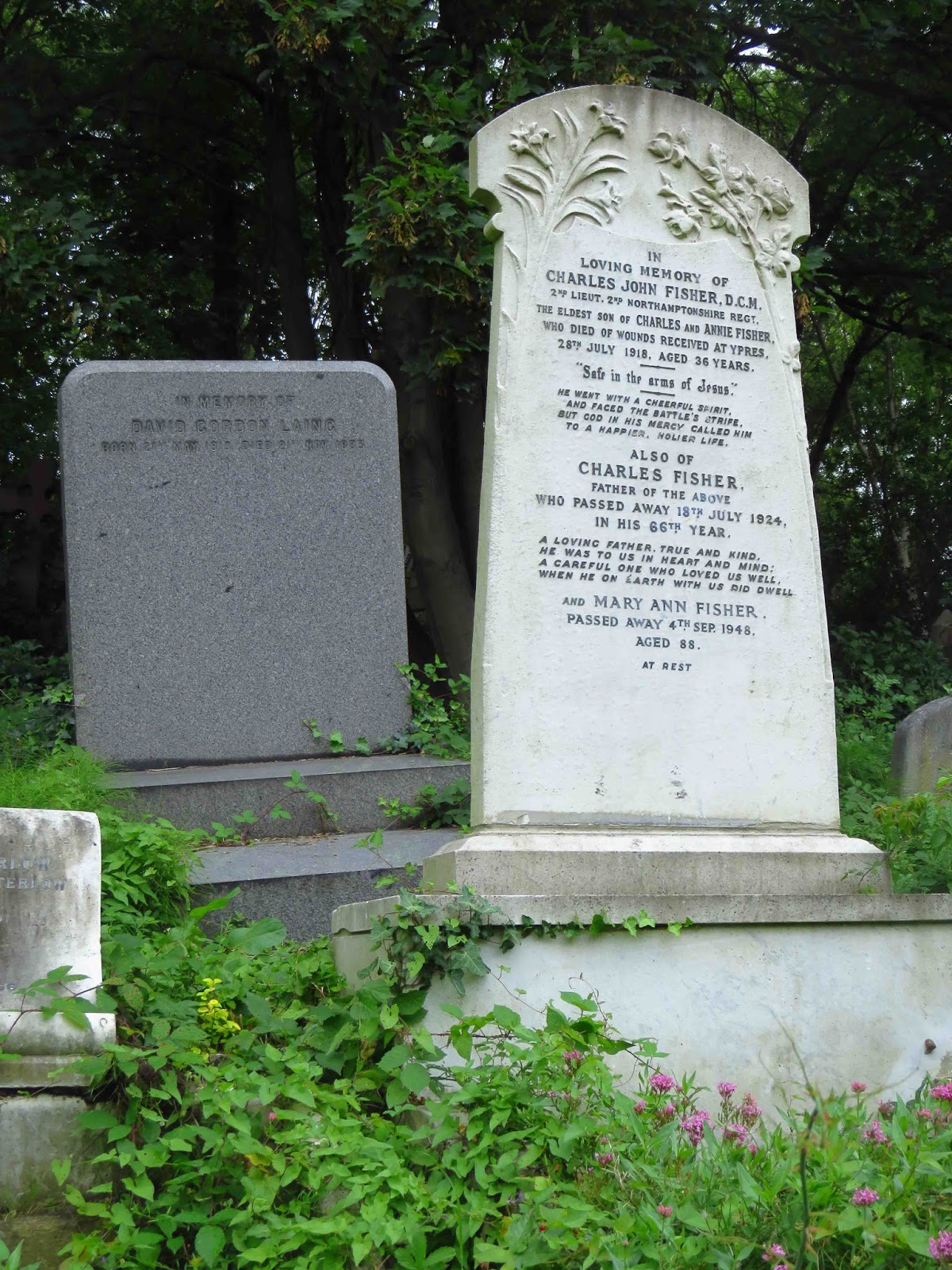
I’ve been in London for a few days and with a friend (who has been persuaded to appreciate gravestones – she has even spent a couple of days with us on our survey in North Yorkshire) took the opportunity to visit the famous Highgate Cemetery. Born and brought up in North London, I know I have been there as a child, but remembered very little about it. It is an extraordinary place, but the volunteers who run the place have a huge task on their hands to maintain it. The main circular path is well-kept – of course, this is lined with all the most ornate and showy monuments, as you would expect. 

Off the main paths are side avenues, some more “romantic” than others, under the shade of trees and undergrowth of thick ivy. The grave plots here are crammed in so tight you cannot get close to the masses of ivy-clad gravestones behind them without stepping on another memorial plot. 


The great majority are tilting, and many have parts missing or broken – the result of years of neglect before the present day Friends of Highgate Cemetery were formed and took on the huge task of caring for the place. New graves are still being added – along the main path especially, there are many modern gravestones nestled against Victorian counterparts. 

The curious mix is enchanting, as is the cosmopolitan mix of nationalities and cultures represented. Many of the latter are clustered together in their own zones, while there are other areas where different cultures lie in a diverse mix.


Highgate Cemetery has a very different atmosphere to Arnos Vale in Bristol – the latter feels like an open space, a garden landscape where people go to stroll or walk the dog – which was one of the original intentions of large urban cemeteries; at Highgate there is more of a sense of inner reflection and meditation, which can feel quite morbid and “gothic”. The monuments – whether hidden or visible – take centre stage rather than the landscaping which has long disappeared under the ivy and the overcrowding, creating a romantic atmosphere that many visitors may find a little forbidding. For me, of course, there was the sheer frustration of not being able to investigate the gravestones, and look at them in detail. That apart, I found it very beautiful and charming. The volunteers are doing a wonderful job against huge odds – and proved very friendly and helpful too.

Large privately run cemeteries like this are such a stark contrast to the little parish churchyards that we are currently studying. The ostentatiousness of the larger Victorian memorials is sometimes even outstripped by modern monuments in such places. Apart from the sheer size of many of the memorials along the main path, the variety of types of crosses and angels was particularly striking at Highgate. It is sad, though, that the vast majority of Victorian gravestones of a more modest and typical form will probably never be revealed, but will forever lie hidden under the thick growth of ivy. This does give a somewhat distorted impression of the nature of Victorian memorialisation. 


On the other hand, it does make for a lovely nature reserve - and a haven for local cats to explore.

Unfortunately we were unable to visit the West Side which is only accessible by guided tour – We fully intend to book a tour well in advance next time.


Jane Lunnon