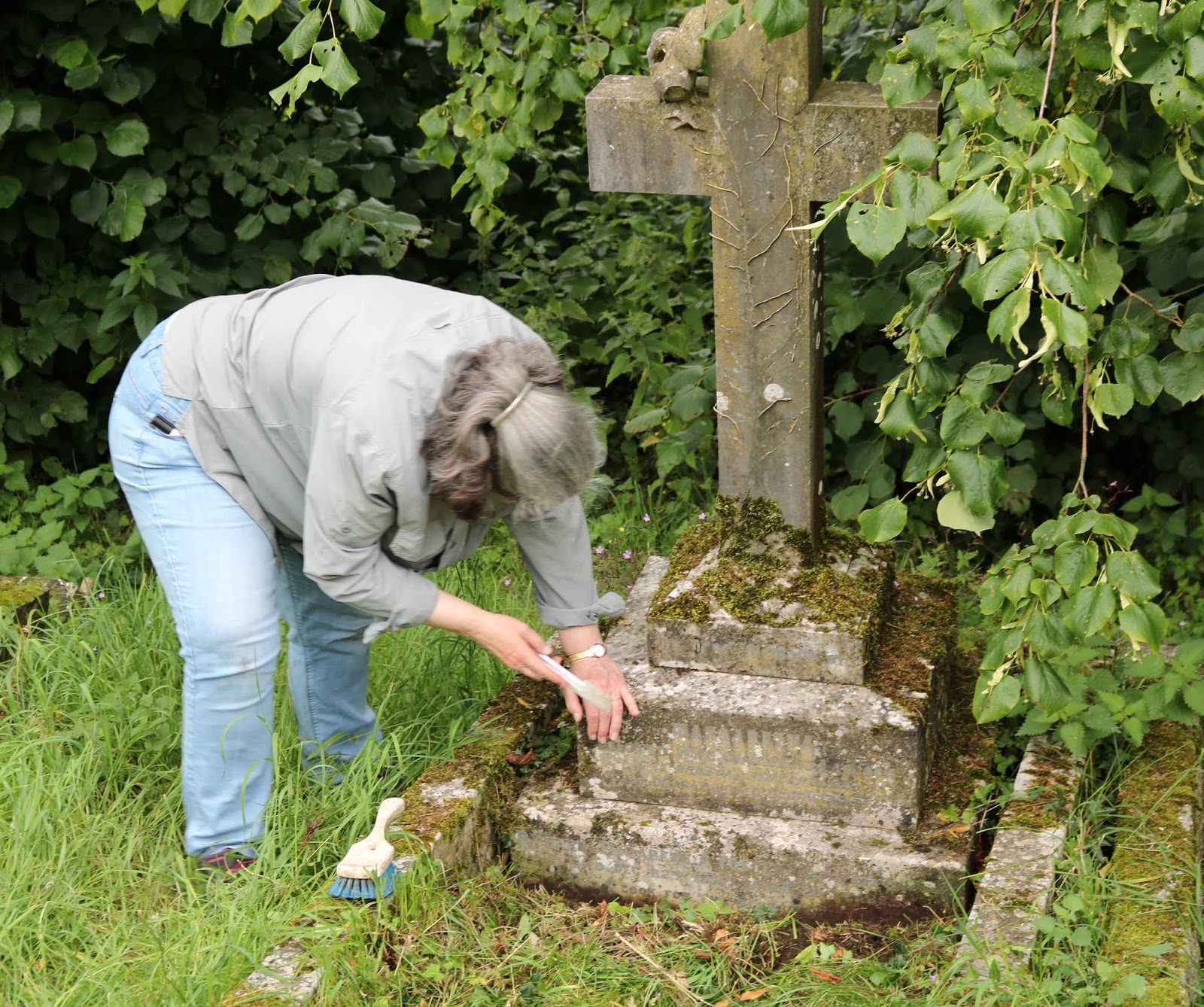
Wednesday, 4 March 2020


Saturday 29th February 2020


Today we re-launched the Embsay-with-Eastby Walls survey, which we had abandoned a few years ago due to various problems.


We (the old hands - myself, Chris & Tony) met our new volunteers at Bobbins cafe in Embsay Mills. After a bit of breakfast, Chris explained the project. Out came his copy of the 1847 Tithe map for the parish, on which Chris has allocated a wall reference number to each stretch of field boundary. Each of these will be photographed, and recorded with a description and measurements. Hopefully we will end up with a characterisation map from which we get some idea of how the field systems developed over the centuries.


The weather held out surprisingly well, despite dire weather forecasts, so we set out for a training session along Brackenley Lane. It was a bit awkward as Saturday is a relatively busy day of the week for traffic along the lane, which despite being single track country lane, is used as a bit of a race track by some motorists. We split into two teams, although one team had to leave early for another class in the afternoon. The team which remained behind did extremely well, picking up all the recording processes without any difficulty, and we were very pleased with how much progress we made before the chill winds and sleet drove us back into Bobbins for a warming coffee. 

Jane Lunnon.


Friday 13th February 2020


Today we were back at Conistone, St Mary’s, to continue with the total station, kindly brought over by Toby from the DEBS project. He also brought with him two postgrad students, Laura and Erica, who wanted to learn about RTI photography. 

Since Alan was away on holiday I demonstrated RTI, with Tony’s help, and then let the students carry their own RTI on a gravestone. 


Then it was into the very cold church to process the photographs on the laptop – again I demonstrated the process, then let Erica and Laura process the second set of photographs by themselves.

They did an excellent job – picking up the whole technique straightaway. They were a delight to teach, and I really enjoyed my day with them both. 

Meanwhile the others tried completing the GPS survey of gravestones on the north side – but as the weather started to close in they were hampered by various factors, and by lunchtime had managed 2 rows. Over lunch we could see the skies darkening and sadly, decided we had to call it a day. 

Jane Lunnon 


Monday, 10 February 2020


Friday 8th February 2020


Although it’s been a mild winter (yes, I’m on about the weather again, but it does have such an impact on our outdoor work!), we have had few opportunities to get out and get on with our photography at Skipton Holy Trinity churchyard. 


The answer's 42, Jen!
At last, on Friday, the weather proved perfect for RTI. We had a successful day – all the technology worked, and there was enough shade in large parts of the churchyard to enable us to select several ledgers for photographing. 

Setting up remote view from camera to laptop to ensure the ledger is framed well in photographs
Neither did it rain, nor did we get gusts of wind. It was cold, but we warmed up in the church café at lunchtime. The only real problem we had was that many of the ledgers were still very slippery, so we had to tread carefully – wherever possible keeping to the narrow grass paths. It’s surprising how much that slows you down. 


There is still much, much, more to do; but we felt we were making progress again. 


Ledgers ranged against a high wall pose a slight problem 
in that only half a set of flash-angles can be photographed
Our advice to any other group carrying out a similar project would be to have patience – RTI is so weather-dependent that you need to be willing to wait for the right conditions – and that may mean several months before you complete the outdoor work on your churchyard survey. 


Jane Lunnon

Tuesday, 17 December 2019


Wednesday 11th December 2019 


We spent a cold dreek morning at Holy Trinity Churchyard today – a combination of wet stones from last night’s heavy rain, and the morning’s bright sunshine meant half the churchyard wasn’t suitable for any RTI photography of ledgers. However we did select a few up in the shadow of a boundary wall. 


Sue & Jennifer discuss a plan of action for the day
While I focused on taking as many ordinary photos of ledgers as I could and Sue carried on collecting data on gravestone measurements, Alan, Tony & Jennifer set up the RTI camera scaffold. But then they hit a snag as the camera and flash unit refused to work together. 


After several hours of only partial success with the RTI we called it a day. It had clouded over anyway, and was getting bitterly cold and drizzly. 
Packing up as the clouds threaten rain
We retreated into the little café at the back of the church and had a nice long chat over lunch before going home.

Jane Lunnon

Friday, 22 November 2019


Wednesday 20 October 2019

Sue and I spent half a day back at Holy Trinity churchyard, Skipton. Sue started on the measuring of gravestones and managed to complete all the uprights, before moving on to a row of ledgers.


I was able to crack on some photography – as always with ledgers, cleaning them in preparation for photos took longer than taking the actual shots but at least it was a still day and there was no breeze to blow back the autumn leaves. 

By 2pm we were so cold  we had to call it a day – a good excuse to get a late lunch at the new Bobbins coffee shop in Embsay. 


Jane Lunnon

Thursday 24th October 2019 


We attended a day workshop at the King’s Manor, University of York. Our colleagues from the Friends of Raikes Road Burial Ground came along too and we were delighted to meet up with members of some of the other groups working with the project. 
DEBS workshop at Kings Manor, York - photo courtesy of Jean Robinson


Toby Pillatt introduced us to his colleagues on the DEBS project, including Dr Debbie Maxwell, Professor Harold Mytum and Professor Julian Richards. We spent a thoroughly enjoyable day being updated on the progress of the DEBS project and trying out some of the prototype resources.

All too short a time was spent in the churchyard of nearby St Olave’s – for health and safety reasons normally closed to the public. Here we tried out the latest version of Harold’s paper-based forms for recording gravestones, as well as the mobile app. 


The latter is still only in the very early stages of development but we can see great potential in it, despite some misgivings. We were able to make some suggestions on how it can be developed further.  Harold’s paper forms, on the other hand, are pretty much in their final draft. They are easy to use, and Jennifer and I sailed through them, entering data on a couple of gravestones. 


Back in the lecture room we tried out some data entry onto the prototype database and made some suggestions as to how it can be improved for use by community groups such as ours. 


The day finished with an informal chat about the potential of the project and ideas for the next phase.

Jane Lunnon

Tuesday, 22 October 2019


Friday 18th October 2019


We were very grateful today for Toby Pillatt (DEBS project) joining us as he brought along a total station borrowed from the University of York.
It took some time to set it up but once we got going we were, with his help and guidance, able to plot in the precise locations of all the gravestones on the south and west sides. At times there were interesting problems such as trees which broke the line of sight between the total station and the prism, but with all hands brought in to hold the branches back we were able to get all the readings we needed. 
photo by Sue Stearn
Sometimes the total station refused to take readings due to “wind turbulence” which we suspect was sometimes due to us giggling too much! So we hold our breath and tried again.


Having tried before to take GPS readings without any success due to the tree cover, it was a relief that the total station appeared to work well. Even when other gravestones initially broke the line of sight to one we wanted to record, we were able to use prisms of different heights to find the appropriate position to take a reading.


Our method was to always plot in the left side of an upright gravestone before the right side (ie. as you are facing the inscription). With box tombs and ledgers (recumbent stones) we always started with the top left corner and worked clockwise to plot in the other 3 corners. Where we had a surrounding feature (such as railings of kerbstones), or a secondary memorial within the same grave plot, these were plotted in separately, in the hope it will be clear on the final plan how they relate to the main memorial. Each gravestone was of course given its own code reference (generated by the total station) which we can later cross-reference to the grave-ID.


While 3 of us were learning how to use the total station, Alan and Tony caught up with some RTI photography which needed re-doing – the lighting conditions were much better than they have been on some days, in particular because there was no dappled sunshine on some of the memorials under the trees.


On the north side of the churchyard the church sidesman had arranged for extensive clearance of the old vegetation which was beginning to die back for the autumn – a huge amount of nettles, weeds and brambles have now disappeared, revealing more gravestones, which gave the photographers the opportunity to record them after they had been hidden all though the summer.   


Our thanks to Toby – hopefully he will soon be back to help us finish plotting in the remainder of the churchyard.


Jane Lunnon


Saturday, 28 September 2019


As mentioned earlier, here are some retrospective blog posts from Jennifer:

Friday 21st September 2019

This week was spent mostly up ladders – at least for those of us who were volunteered! We were blessed with good weather so took the opportunity to re-photograph some of the table graves , however they are too tall and long to photograph without a ladder, therefore the shortest (and youngest) person went up the ladder, kindly supported by two arm rests so that photographs could be taken, one handed and blinded by sunshine. Some were even taken upside down, or between other graves in an attempt to accurately record the inscriptions. The rest of the team were finishing off recording gravestones with a little less gymnastics. There’s not really much else to say, the week was mostly about catching up and finishing taking photographs, the only downside was that we used up all the camera battery and ended up sharing one camera between us all! However on the upside there was no-one to take photographs of us practising the sometimes extreme sport of graveyard surveying. 


Under sufferance my mother has allowed this photographed to be used, solely because it has the step ladder in! (I promise I was trying to take a picture of the gravestone really!!)

Jennifer Stearn

Wednesday 23rd August, 2019


The weather at last had sorted itself out with sunshine on the cards; brilliant for plain photographs, but next to useless for RTI, but never the less we persevered. Splitting our time between Holy Trinity Skipton and Conistone churchyards we made a happy caravan of taphopiles. The sun just about remained behind the clouds for several tricky RTI’s, eventually setting aside the infamous table top RTI and finishing at a reasonable time, once the sun had made itself well known.


The challenge of doing RTI on a sunny-with-cloud-interval day and the different angles and conditions of each grave certainly challenged us all. Interestingly it took four of us to do one grave, one taking the pictures, one holding the flash, one holding the string and one holding the coat. The coat was very key to blocking the sun, but also provided a rather strange line up for passers-by. Owing to the fact that we left behind the very useful if slightly “Heath Robinson” garden cane to hold the string, we even had to fashion a string-hold stick out of a handy branch - with only minor puncture wounds. Obviously we worked very hard and didn’t do any dancing or eating of chocolate cake!


Jennifer Stearn


Friday, 25th August, 2019


With the sun inching out between the clouds at very awkward moments we attempted the intricate art of horizontal RTI’s, with same added slope work. The bar, once eventually set up and strapped together and screwed the right way, we realised why we need tall people with allen keys. But once the bar was set to the magic height of 130cm above grave slab we got into the swing of things, right as the sun made everything rather useless.


There aren’t many people in Britain who are unhappy when the sun comes out, but we are some of the few. It is a very good thing that we were all too busy and otherwise engaged in the very careful and slow dance of the RTI photographing that we couldn’t take pictures because we would have had some very interesting angles and shapes. 


We also learnt that it is very difficult to angle a flash when perched precariously on a grassy slope, and even more difficult to swap sides when the string attached to the flash is attached to cane that someone else is holding. Despite the challenges, we managed some work and briefly mused on the challenges yet to come of performing RTI on half a step in the sunshine, hemmed in by walls and gates.


Jennifer Stearn

Saturday, 14 September 2019


Saturday 7th September 2019


It was the Embsay-with-Eastby village fete today so we set up our little History Group stall. We were in a prime position which was excellent, and the sun came out encouraging a good turnout of residents. 


Our village has a wonderful community base and there’s always a good atmosphere at village “dos” like this. 


Our display was on the history of the Post Office, which from the 1870s to the present day has moved several times, mostly within the Elm Tree Tree Square – Shires Lane area at the top of the hill. 

We made several new contacts and were able to talk to many people about the village history. There certainly is an audience for our work. 
Overall a very satisfying day.

Jane Lunnon


Wednesday 4th September 2019


I missed last week’s session at Conistone, but Jennifer will fill you in with another post on what happened as they continued to battle against the vegetation. 


Despite the intermittent showers we were determined to get out today to continue at Skipton Holy Trinity Churchyard. 
A small team arrived and immediately started work on more memorial inscriptions checking, while I continued taking photographs on Row C. As always preparing the ledge stones – clearing away the weeds, and brushing them clean – took much more time than actually taking the photos, but it’s worth the effort for a good photographic record. 


We beat a hasty retreat from a short sharp shower and had a brew and some cake in the church vestry tea room. 
Jean chats to Tony about the Holy Trinity Project
We hadn’t been back out long when Toby Pillatt from the DEBs project, based at the University of York, arrived. He was interested to talk to Jean about the Holy Trinity survey and her other project at the Raikes Road Burial Ground. By looking at how different groups manage and organise their churchyard surveys it should help him develop the resources for other groups. 


About lunch-time we all went into town for a quick meal. We were able to have a very interesting conversation about churchyards, and the problems associated with contracting professionals to carry out churchyard plans, while voluntary groups struggle to finance expensive total stations or manage GPS under various conditions – such as tree canopies.  


The Embsay contingent took Toby to see St Mary’s churchyard at Embsay and despite getting soaked in the rain again we hope he found it interesting and informative.


Jane Lunnon

Wednesday, 14 August 2019


13 August 2019

Another really nice summer’s day for us at Conistone again. We had a full house with 9 of us turning up.

Alan and Tony tried yet again to carry out some RTI on a particular table top gravestone which has been proving troublesome. Alan has today tried a new ball-head to clamp the camera to the horizontal bar to see if that helps frame the composition better and allow the camera to be held closer to the memorial. Let’s hope it works.

Lynne and I worked steadily along the final row of graves of modern burials. 
Lynne - dangerous with shears!
Although we didn’t manage to finish it we made good progress, most of our time as usual spent in preparing them for photography. This has the added advantage of helping to tidy up the gravesides in case any relatives visit. Indeed, the areas we cleared last time around another couple of rows – previously at least waist high in nettles, brambles and wild flowers well past their spring-time best – had now been lovingly dressed with bouquets of flowers by visiting relatives, adding a wonderful personal touch and bright colour. 
A few of the newly laid flower bouquets
We felt very moved by the sudden appearance of so many fresh flowers in the churchyard. It brought to the fore that vexed question again about the right balance between allowing churchyards to be nature reserves, paying the costs of maintenance as congregations shrink, and the need to cater for those who visit the graves of relatives and ancestors.

The rest of the team set to work in the far corner where the tall plant growth is known to be hiding several gravestones – although we had decided these would have to wait until the vegetation had died down in the autumn, the tantalising glimpse of the corner of a raised cope-roofed ledger stone was too much to resist. 
As all of the team had experience of archaeological digs, they enthusiastically set to in order to uncover the stone. 
It took pretty much all day – the going was tough – but also the stone was revealed to be just the centrepiece of a much larger family plot which was defined by large lintel kerbstones punctuated with large side and corner posts. To add to that there was another small memorial next to it – a single plot defined by more kerbstones. 
The double memorial finally exposed ; Alan prepares for RTI
The inscriptions needed some RTI photography, but enough was readable to show that it included a memorial to a young man who had died in the First World War. 
Measuring up for survey data
 We were also visited by the senior sidesman again, who helped clear up some grave-id queries. And by a local lady who was able to provide some family history on her relatives. Another lady also brought her little grandson to lay flowers on her grandparents’ grave and a couple of passing hikers popped in to visit the church too. 
A well deserved tea break


Jane Lunnon.

Thursday, 8 August 2019


Tuesday 6th August 2019


Again the weather forecasters got it wrong – we expected to be rained off by noon but although dark clouds threatened us, it never actually rained and we managed to get quite a bit done. 
Cleaning a memorial for photography, and measuring another
One of the things which has struck us is that in this churchyard the unevenness of the ground, and the sloping down to the west has created enormous problems with stabilising many of the gravestones. Modern memorials in particular have succumbed to collapse – many have not been fixed properly to begin with, and we have discovered several gravestones lying hidden in the undergrowth. 
Perhaps then it is not surprising that the most recent burials tend to favour the local Wharfedale custom of using natural, undressed limestone boulders instead of conventional memorial uprights. Yet even here poor craftsmanship had led to the memorial plaques falling off and being lost on some of them. Poor record-keeping in the past has meant we have a large number of un-marked plots without any information on who was buried there – and where the plaques are missing even a few graves marked with the limestone boulders are as yet unknown. Hopefully we can find someone local who can remember who is buried under those at least. 

Natural limestone boulders used instead of standard kerbstones
Another local variant we have found here, on some of the more recent grave plots, is the use of long limestone pieces, again undressed and in their natural irregular shapes, used to form kerb surrounds.  
Jane Lunnon

Sunday, 4 August 2019


Friday 2 August 2019

They said it would rain by lunchtime but in the event we had a very pleasant summer’s day until we left at about 4pm. 
Cleaning up in preparation for photography
Tony and Alan did some more RTI photography. 

Tony & Alan work deep undercover
Meanwhile Sue and I worked on the North side, spending most of the morning cleaning up and exposing the kerbstones of three grave plots which had become completely enveloped in moss. Two of these were unusual in that they were made up of natural limestone rocks. 


We had several visitors today – the senior sidesman stopped by to help us sort out some queries on grave-ids; we had a very nice chat to a passing hiker who had a particular interest in family history and was curious as to what we were up to; two hikers came to see the memorial to cavers who died at Mossdale in 1967; a family on holiday strolled through as part of their leisurely exploration of the village; and a local resident chatted with us when she came to tend a grave. It served to emphasise that any churchyard, no matter how unassuming,  is such an important local asset – as much there for the sake of the living as for the dead.  
Jane Lunnon


Tuesday 30th July 2019

It was a hot, hot day.  Beautifully sunny despite the dire warnings of impending thunderstorms. The moths and butterflies were out in force today, emphasising how important such burial sites can be for wildlife. We did feel a little guilty about clearing away some of the vegetation, but there was plenty left elsewhere in the churchyard for them to retreat to. 
Tony had brought along a petrol-powered strimmer which would work much better than the battery-powered one to clear away the thick stems of nettles and brambles from the frontages of the gravestones we wanted to record today. It took him all morning and it was extremely hard work, but he managed it. He did a grand job.

Meanwhile, Jennifer and I spent much of the morning preparing a particularly overgrown burial plot to reveal a memorial of the 1960s which has long since collapsed into pieces. We felt it especially important to do a good job not only for the photographic record, but also because it is obviously still visited by relatives who had recently left fresh roses at the graveside. 
Sue and Lynne worked on the north side to record some of the newer gravestones there.

Sue amused by the use of a beer can as a flower vase
While having lunch we heard the thunderclaps approaching and decided to call it a day – none too soon, as we were battered by heavy rain on our drive homeward.

Jane Lunnon

Monday, 29 July 2019


Tuesday 23rd  July 2019

An extremely hot and muggy day – not the best conditions for hacking away at brambles, nettles and 4 foot high vegetation, but we were at least able to cool off every now and then with cold drinks inside the church. 
We were pleased to have the company of Dr Toby Pillatt, who is working on the DEBs project and came to see what our methodology was, and to talk about our project and how it fits in with the DEBs project at the University of York. 
RTI demonstration for Toby Pillatt

Alan, Jennifer and Tony spent the morning with him demonstrating RTI photography – on both vertical and horizontal gravestones, which call for two slightly different approaches. Luckily, despite the bright sunshine, they were able to find some gravestones in the shade, although as Alan pointed out, bright sunshine is slightly less of a problem than reflective white cloud cover.

The processing of the RTI photos taken in the morning proved a little problematic – but at least it proved that the software can be temperamental – easy to use when it goes right, and you know what you are doing, but it can fall down at the slightest error or hitch. It certainly needs improving if it is going to be used on a large scale by community groups who may have limited confidence with computers.

Lunch-time gave us an excellent opportunity to discuss the technical aspects of our survey as well as funding issues, the development of the field survey app prototype, and database.

Eileen learns how to create a detailed photographic record of a gravestone
In the afternoon we braved the increasingly hot and stifling outdoors to show Toby how we survey a churchyard.  He joined in enthusiastically, helping to measure up and fill in the forms, although we spent more time clearing away the weeds and scraping off the moss to reveal inscriptions, than actually recording memorials!

Careful excavation of a collapsed gravestone which had become completely overgrown 
- final picking out of letters ready for photography
The undergrowth was so high and dense in some places that we agreed several gravestones would have to wait until the autumn before they could be recorded as they are at the moment completely hidden and inaccessible. Besides, the wild flowers were lovely and we didn’t want to disturb it too much since this is a haven for insects and birdlife. 
We can understand that the balance between maintenance of a churchyard to keep gravestones clear and accessible for visiting relatives; the increasing difficulty of financing that maintenance (which if the congregation is small and there are few willing volunteers available, can be very expensive since contractors have to be employed); and allowing churchyards to become nature reserves (for which they are ideally suited), is a very difficult one – perhaps without a real solution that is acceptable for everyone.

Jane Lunnon


Thursday, 18 July 2019


Wednesday 17 July 2019 

A hot, muggy day – Skipton bustling with locals and tourists. We spent just the morning in the churchyard. 

Despite the direct sunlight, the team had quite a bit of difficulty, struggling to read some of the inscriptions. Hopefully, when the RTI photographs are completed these inscriptions will become beautifully and immediately clear. But in the meantime it was quite fun listening to the various attempts to decipher the words and letters, while I was doing some photography at the other end of the site.  


It was hot work, since I like to have “clean” photographs of gravestones, without shadows or weeds and grass obscuring even the edges of the stone. At least I didn’t face the scale of vegetation that we had yesterday at Conistone! Nevertheless, I had to spend about 20 minutes cutting away the vegetation and sweeping off the dust, flower petals and leaves before I could start the photography on each memorial. In the hot weather that was a bit of a slog, but I do think it worthwhile to make sure the photographic record as good as possible.


Naturally, our morning tea break was a little longer than usual as we relaxed in the shade, but it was a good opportunity to discuss local archaeological sites around the town – and in our home village of Embsay - and bemoan how local heritage and historic landscape is being lost forever under the housing developments sweeping around what was once a lovely market town and a small village in a distinctly rural area. The least we can do with our small-scale resources is to continue recording the graveyards. 

Jane Lunnon